Friday, 4 April 2014

Cookbook Research (3)

I found a number of interesting children's cookbook from The Independent's website: http://www.independent.co.uk/life-style/food-and-drink/features/the-10-best-childrens-cookbooks-8588949.html

Pretend Soup and Other Real Recipes
- By Mollie Katzen.
- Aimed at "preschoolers" - 3-6 years old. This is not the target audience for my brief, however, I thought it would be interesting to see a cookbook based on a younger age and how it differs from books for my target audience (eight year olds).
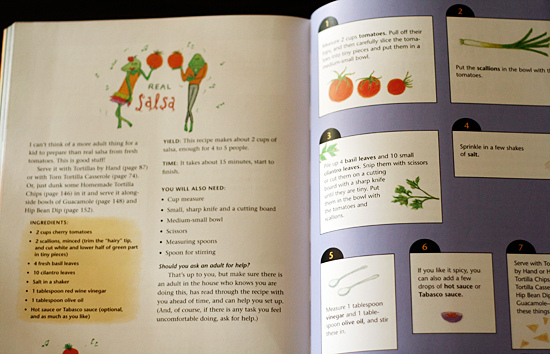
- The front cover is coloured in muted tones. It has a easy-going visual language that appears friendly. However, I'm not sure if this is dynamic enough and would stand out on a shelf. This front cover is definitely aimed at the parent and not the child.


- The interior of the book is vastly made up of simplistic illustrations. There is little detail to these illustrations, their shape being emphasized and obvious for the young children to understand.
- There is very little text. The text that does appear is made up of short, to-the-point instructions.
- Colours are flat. Illustrations are loose-lined and playful. The layout is very simplistic, making it easy to understand.


Honest Pretzels

- Also  by Mollie Katzen.
- Suggested age range is for children 8+. This provided me with a clear differences between a cookbook aimed at an audience younger than 8 and one aimed at 8 year olds.
- Much more text has been included and the illustrations are now smaller. The text takes the front, rather than the other way around, how it was in Pretend Soup.
- Children at eight are more able to understand recipes. Simplicity is not necessarily needed.
- Yet again, the layout is fairly simplistic. Instructions are boxed in.


Food is Fun!
- Designed by the makers of the Anorak magazine.
- Age range: Suitable for over 5's.
- A heavy focus on the graphics/artwork of a cookbook.
- Creative, intriguing, inviting, playful.
- Simplistic shapes, bold imagery, bright, often contrasting colours - this will appeal to a child audience.
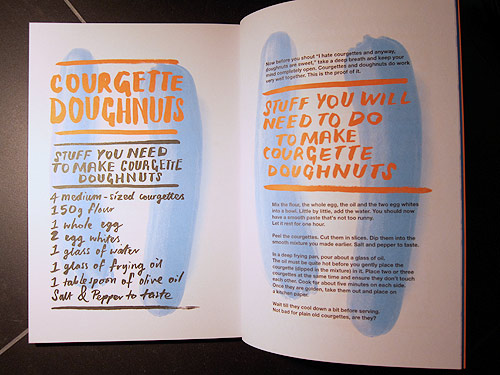
- The typeography is loose, looking hand-rendered. This adds to the playful, less professional feel. It therefore seems more approachable for children.
- Minimum of two colours per page.
- As can be seen above, it also features games.
- Introducing unusual, playful layouts. Including characters, which children will engage with.
- Overall, this is an incredibly fun cookbook for children. It places focus on the artwork and gets children involved this way.


A Zombie Ate My Cupcake

- By artisan baker Lily Vanilli.
- I couldn't find a suggested age-range, yet I would guess (from the text-heavy pages and ambitious recipes) 8-12 years old. 
- A fun, quirky horror-themed baking guide. Kids love horror and gore - so I'm sure this was a hit.
- 25 recipes for spooky treats.
- Layout: Photography on one side, information on the next. On the example above, the right-hand side page seems a little bare. Perhaps something else could have filled up that blank space.
- Horror-themed typography. Relating to the contents of the book.

- Bold, gory imagery that breaks the mould and leaves an impression.
- Consistent art style and layout throughout the book.


Star Wars Cookbook
- By Lara Starr.
- Age range: recommended at 8 - 12 years. There is a lot of text, which is suitable for this audience, yet may be too much for younger children.
- Cookbook based on books, TV shows or movies are very popular among children. Each recipe has a Star Wars twist.
- Photography on one side, instructions on the other. However, the photography blends across the page, becoming the main focus and, as it is the most exciting aspect on the page, this works well.
- Plain typefaces that are easy to read. Black text; colour is left to the photography.
 - Ring-binded, easy to open, flick through pages etc.


References:
http://www.independent.co.uk/life-style/food-and-drink/features/the-10-best-childrens-cookbooks-8588949.html
http://www.sturdyforcommonthings.com/2013/09/review-pretend-soup-and-other-real-recipies/
http://www.anorakmagazine.com/books/food-is-fun.html
http://atomicvoodoo.blogspot.co.uk/2010/09/aaaagggghhhh-zombie-ate-my-cupcake.html


Thursday, 3 April 2014

Ebooks: Blog Task

The Princess and the Pea by by TabTale LTD

Age range: Recommended as 4+. The characters, storyline and interactions are fairy simplistic so I would recommend this for a young age group, such as 4-7.
Features:
Can choose between a "Read to Me" option, which includes a narrator who automatically reads each page, "Auto play", which was automatically read the entire story, or "Read it Myself", where you can record your own voice-over for each page.
On the pages there are background noises, such as the ticking of a clock. The narrator provides a steady voice to engage the children in the story.

The pages are interactive; when you tap one of the characters or objects with your fingertip they move and perform an action sequence. Most pages are very busy, with lots to interact with. The child can choose when they are done with the page and want to skip onto the next one by selecting the arrows. It is a linear storyline.

There also includes mini games, which isn't part of the main story. This includes counting games, jigsaws, painting, developing memory skills and dress-up games. The dress-up game involves the user in character design. You can design the look of the princess that will follow through the game. This adds personalization.

 The additional features engage the child in the story, which encourages them, in turn, to get more involved with reading.

Some pages, however, are quite repetitive and there is little to interact with. These pages rely on the story and the movement of the characters to stop the child from becoming bored. I think these pages could be improved by adding more stimuli.

After you have played around with various objects, there is little else to do on the page. The movement of the objects are usually quite similar too. Perhaps further games could be added to these pages or there could be hidden objects to discover.


Who Stole the Moon by Windy Press


Written by Helen Stratton-Would. Illustrated by Vlad Gerasimov. Proudced by Windy Press.
Age: Again, this is recommended as 4+.
Features:
- Glimmering stars appear where the player touches the screen. Later on in the story, characters also appear when you click.
- The main character reacts when the user clicks on them. They move, jump into action etc.
- As in the other app, a narrator talks through the story.
- There are parts of the story where there is more to interact with on the screen. You can play with the objects in the character's room, for example. Though the idea is similar in The Princess and the Pea app, Who Stole the Moon achieves this more successfully. The objects do more than flip and move about; the lamp turns on and off, papers can be moved around, the globe spins etc. The actions are specific to the object and this becomes more fun and engaging. You can also drag objects across the screen; it gives you more choice than stationary objects.
- Eight songs are also available as separate to the story. You can listen to  a song, or sing it yourself in karaoke mode.
- There are also four games: Catch The Dragonfly!, Coloring, Memory and Puzzles. These games also encourage learning, as does the story, which encourages children to explore reading.


 Jack and the Beanstalk by Nosy Crow


- Nosy Crow is a company that is currently dominating ebooks. 
- Age range: 4 – 8.
- Nosy Crow refers to this app as "where on-screen gaming and reading meet".  This app definitely blurs the edges between a story and a game. The interaction level is very high. You can move objects, solve quick puzzles, interact with the game's environment and characters, move the character "Jack" through the story, and all while getting involved in the reading side.
- There is background music and sounds that help the child get more lost in the story.
- The various challenges and mini games will keep a child engaged for hours. They also teach problem solving.

 - If you wake up the giant at different points in the narrative you create new endings, so your decisions are effecting the line of the story.
- Non-linear narrative. You can work your way through the castle in different ways every time.
- There is also a text-highlighting option to support emerging and early readers.


References:
http://www.tabtale.com/
http://www.windypress.com/whostolethemoon/
http://nosycrow.com/

Wednesday, 2 April 2014

Ebooks and Children

Children are starting to bombarded with interactive multimedia; ipads, tablets, laptops, Nintendo, smart phones etc. And this also includes ebooks. Children are starting to expect a certain level of interactivity and ebooks can provide that, while also encouraging reading.

Patrick Carman, author of young adult and children's books, has talked at numerous schools. During his Ted Talk lecture, he explains - worryingly - that books don't feature in children's "Top 5" things to do anymore. Instead, they have become hooked on entertainment media; ipads, phones, laptops etc.

The 2010 Kaiser Family Foundation report shows that children (aged 8-18) spend a staggering 7 hours and 38 minutes using entertainment media per day. If you factor in doing two things at once, such as texting and watching TV, it jumps to 11 hours per day. When you consider that the average child is awake for 15 hours a day, this seems incredible.

Carman came up with a way to encourage more children to read. He did this with his book "Skeleton Creek". Intervals are broken between chapters of the book, where, after reading about 20-30 pages, the child comes across a password. This password can be used online to unlock a short clip that relates to the story. Children can go back and forth several times between the book and TV clips. This has encouraged children who don't read that often to get back into the hobby.

"The 39 Clues" is a series of ten books by seven different writers. The book includes a "hidden panel", where you can take out collectable trading cards. You can also take this book online by typing the number of the cards onto the associated website. You then became part of the story. You can search for these clues, along with other users, online. Carman explains that the "tech is getting [the children into the story] and maybe the book is holding them". He goes on to say, "The tech is playing a very big role in getting these kids to pick up these books". 


These multimedia elements have set up expectations:


Nosy Crow
Nosy Crow was founded in 2010 and is now a leading company for ebooks, apps and children's books. The books they produce have a target audience for children ages 0-14.

Jack and the Beanstalk:

As can be seen in the clip above, the interactive levels are very high. It is almost like playing a game, yet broken up with parts of the story.

They also  published a post explaining how they went about making their Jack and the Beanstalk story. Seen here: http://nosycrow.com/blog/how-we-made-jack-and-the-beanstalk


References:
http://tedxtalks.ted.com/video/TEDxNYED-Patrick-Carman-0305201
http://www.patrickcarman.com/the-author/
http://nosycrow.com/

Wreck This Journal

By Keri Smith. Bestseller.

Wreck This Journal encourages personalization and messiness. The idea is that you can transform this book into something fun and creative. Illustrative prompts encourage the reader to engage in "destructive" arts, such as painting with coffee, poking holes through the page etc.
It allows you to have fun, rather than go searching for perfection. It is not restricted by guidelines and rules.

Examples:

This adds an interactive level to the book, which allows children - and adults - to run away with their imaginations. With ebooks and more technology competing for children's attention daily, the Wreck This Journal has successfully fought for their attention. Children now expect more interactivity and this book gives them that.


References:
http://rebloggy.com/post/me-drawing-art-blue-infinite-line-create-this-wreck-this-journal-journal-wreck-b/44951883894
http://25.media.tumblr.com/tumblr_mdvhpxcJ8Q1rdotlao1_500.jpg

Monday, 31 March 2014

Jugosa Cocina by Monica Pardo Blum


- Visual illustrations made by Cecilia Andrews.
- This book is designed to "Help the children recognize the value in the food that they eat, think about nutrition, and put their creativity into practice."
- I like the childlike element of the crayon illustration. Immediately, it is obvious that this is a book intended for a younger audience and I believe it would appeal to them too. The colours are bright and fresh - shocking yellow and orange positioned on a duller background to stop the cover becoming overwhelming.

- The interior is unlike any cookbook I have previously viewed, which is what drew me too it. It is an explosion of colour and unusual layouts. I think it looks busy and exciting, which will appeal to the young audience it is designed for. However, I think it might be aimed at children around 10-13, as any younger age might find it more confusing.

- Found illustrations mixed with blocks of text and photography. The title is clearly displayed, as are the needed ingredients. Yet it is the illustrations which stand out and bring the page to life.

- The illustrations are very child-like in themselves, with quick colouring and loose lines.

- I also like how, at the top of the left page, there is an explanation of how many people the meal serves, how long it takes etc. This is symbolized with a pictogram and minimal words.

- Overlapping images and text creates a relaxed, fun layout.


References:
http://blog.agj.cl/2010/01/cookbook-for-children/
http://piclog.agj.cl/index.php?picture=65
http://lapanderetadeldomingo.wordpress.com/2011/12/09/jugosa-cocina-para-ninos/

Friday, 21 March 2014

Thumbnail Sketches

- Children take interest in characters, especially ones that they can relate to.
- Have a character running through the book.

- Layout ideas.

- Inspired by Picture Cook.
- Using info-graphics to explain a recipe.
- However, this may be unsuitable for the child audience, as it may be too confusing.

- Pins to show where the ingredients of the recipe naturally grow.
- Show the importance of buying local food.
- Educational about where things grow.

- Scrapbook style. Informal, friendly.


Monday, 17 March 2014

Target Audience: Eight year olds research

The Kids Cook Monday provides a starting point for parents, explaining how different age groups tackle cooking.

6-7 year olds and up
This age group usually has developed fine motor skills so they can take on more detailed work, like using measuring spoons and forming evenly sized patties. They may still need reminders to watch their fingers during grating and peeling.
They also excel at: Dicing and mincing vegetables, grating cheese; peeling raw potatoes, ginger, mangoes and other fruits and vegetables; slicing and scooping out avocados, greasing pans, using a microplane zester, de-seeding tomatoes and roasted peppers, draining and slicing tofu, rinsing grains and beans, forming cookies and patties, pouring liquids into small containers, and garnishing (or “decorating”) dishes.

8-9 year olds and up
There is a wide range of skills in this age group. Some 8 year olds are not mature enough to work at the stove. Others have the focus and diligence of an adult. You’ll have to decide if they should continue with the 6-7 year old tasks or if they are responsible enough to do more.
This group can take on more sophisticated tasks such as: Using a pizza cutter and can opener, scooping batter into muffin cups, scraping down the (unplugged) electric mixer bowl and food processor bowl, putting away leftovers, pounding chicken, proofing yeast, skewering food, slicing bread, and chopping hot chili peppers (latex gloves are a good idea!).

From this research, it is clear that eight-year-olds can hold their own in a kitchen quite well. They may still need assistant from adults, especially when doing more difficult and dangerous work, but I don't think that I need to 'dumb-down' my cookbook for them to be able to understand.


Stefania Patinella, director of food and nutrition for the Children's Aid Society of New York City says: "Cooking is about self-efficacy. When kids cook, they think, I can do this! And that self-esteem can be more important than the actual skills they gain at this stage." 

Teaching children how to cook is a wonderful way to encourage them to develop new skills and have them work by themselves, with a little assistant from someone else. It is also a great bonding time between relative and child. Creativity should also be encouraged, perhaps with the decoration of food or adding extra ingredients.

Besides building confidence, cooking can give your grade-schooler the power of choice. Hmm, she might think. I can eat what I want if I can make it myself.

The BBC meanwhile provide references for 8-11 year olds. 
 Along with the skills suggested for 3 - 5 and 5 - 7 year olds, when children reach 8 +, they can start to get involved with planning and undertake activities with a bit more independence. Supervision is still key due to the number of hazards in the kitchen but take a hands off approach where possible.

Activities to try with 8 - 11 year olds
  • Planning the family meal
  • Following a simple recipe
  • Finding ingredients in the cupboards and fridge
  • Using a peeler
  • Whisking, using a balloon whisk or handheld mixer
  • Using heat on a hob, oven and microwave
  • Making salads
  • Opening cans
Gradually introduce your children to the above and make sure they are aware of the dangers involved. If you feel they are not ready, hold off for a while. Cuts and burns are common in the kitchen so always keep an eye on them. However capable they may be, it's easy to get distracted or try to rush an activity.

From this research, I have discovered that my target audience, eight year olds, can be very competent cooks. They just need a little bit of assistance, especially when doing potentially "dangerous" things.


This website also contains recipes for 7-9 year olds:
http://www.kraftcanada.com/recipes/recipes-for-kids-aged-7-to-9-yrs


References:
http://www.thekidscookmonday.org/about/kitchen-tasks-for-different-age-groups/
http://www.epicurious.com/articlesguides/everydaycooking/family/cooking-with-kids-gradeschool
http://www.bbcgoodfood.com/howto/guide/guide-cookery-skills-age
http://www.kraftcanada.com/recipes/recipes-for-kids-aged-7-to-9-yrs