Friday, 14 March 2014

Cookbook Research (2)

James Beard's Fireside Cookbook

- Illustrated by Alice and Martin Provensen.
- Published in 1949 by Simon and Shuster.
- Collage.


 - Ambitious illustrations. Colourful, engaging. So much to look at. Compliments paragraphs of text.


Fairy Tale Feasts
 - Retold tales by Jane Yolen. Recipes created by her daughter, Heidi Stemple. Illustrated by Phillipe Beha.
- Unique illustration style. Exaggerated proportions, such as face shapes, nose etc. Bright, engaging colours and visual language.
- Combining fairytales with cooking recipes.


 - Story combined with recipes. Engages with children more.
- I like how they recipe and ingredients list are clearly laid out against each other. They are easy to read, with space between the lines to stop the text seeming like a plot. Small illustrations also surround them.


The Silver Spoon For Children
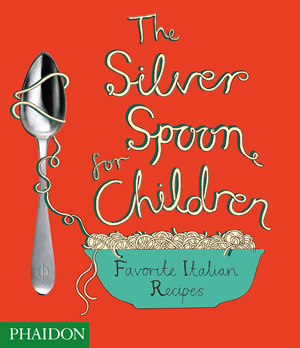
- Age range marked at age 10 and up.
- Published by Phaidon Press, 2009.
- Written specifically for children, with simple recipes.
- Encourages fresh and healthy ingredients, which relates to my brief.
- The book was developed by a specialist in the field of children's food and nutrition. 

- Recipes usually take over a double page. 
- Soft background colours.
- Loose illustrative style mixed with photography. Usually one photo per double page spread, of completed meal.
- I think that the typography is very strong in this book, as it relates well with the adjoining illustrations in visual language. It is also playful, therefore suitable for children's books.


Little Chef
 - Described as a "quirky" children's cookvook. 
- The recipes tend to be aimed at kids, involving "chess puffs", "fishfingers" etc. But I think encouraging kids to healthier, fresher foods could be a good thing. 
- Bright colours mixed with numerous illustrations. 
- "Cute" and "Sweet" - aimed at girls. 
- I made not of the typography used. It is playful, close to being hand-drawn.


Picture Cook


- I was particularly interested in this cookbook, as it uses info-graphics to put across information.
- Frills are cut-off with this book, which allows you, with a quick glance, to understand how to make a main meal.
- Bright colours for illustrations. Outlines. Against white background - stops it appearing overwhelming.
- The author and illustrator, Katie Shelly, had to involve using testing with the process of creating this book. She would get her friends to point out any parts of illustrations that they didn't understand and re-work them.
- She wanted to encourage people to have fun with cooking, to not be too precious about the process. 
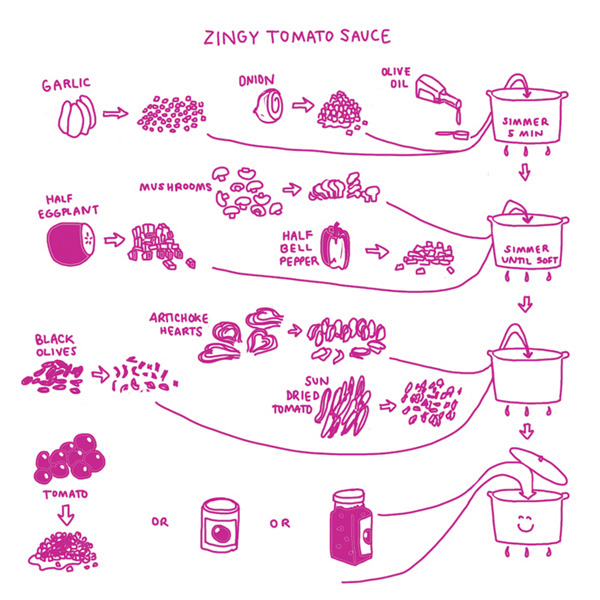


- As you can see from the "Sweet Potato Fries" recipe above, sometimes one or two words are added to the illustrations, but even then there are just that - one or two words. Because of the illustrations, that all the viewer needs.

50's Cookbook Illustrations
- By Bradley Huber.
- I love the clear, simple shapes of these illustrations. It's completely obvious what the images represent. 
- Only green, blue and black have been used in these illustrations, which lends the 50's feel. I find the soft colours calming. 
- Quirky, endearing, charming. Would work well in a cookbook.
- However, perhaps children would need more dynamism to entertain them. 


Children's Picture Cookbook
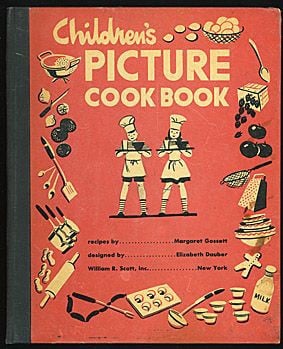
 - Margaret Gossett.
- 1940s vintage cookbook. This can be seen clearly in the simplistic style and minimal colours.
- Easy-to-make recipes concocted with children in mind. 
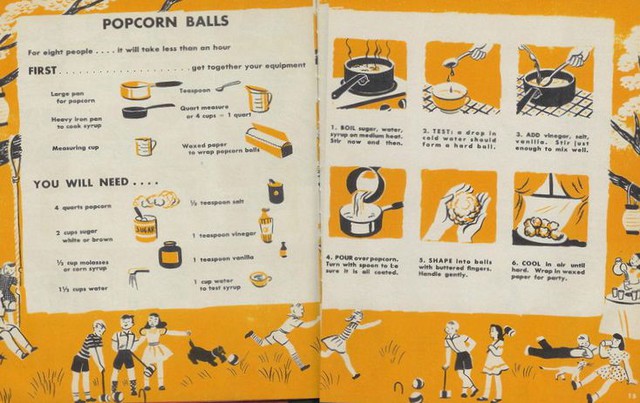
 - Maximum of three colours.
- Each step is clearly illustrated.
- Background images of children playing.
- Minimal text so that it is not overwhelming.
- Understandable layout.


La Cusine Est Un Jeu D'Enfants
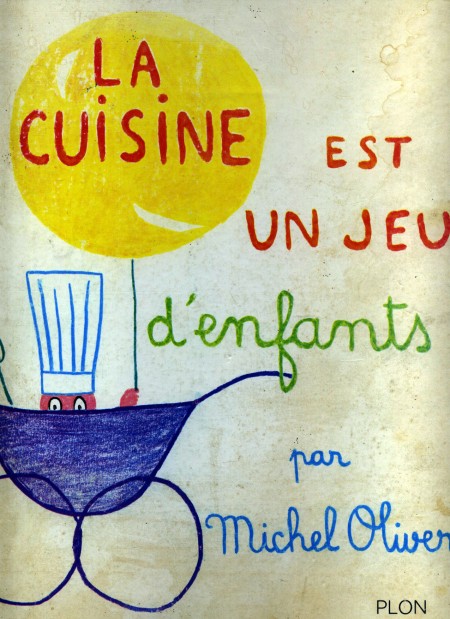
- By Michel Oliver
- French cookbook.
- Age-range is marked as 3-7.
- Ambitious recipes.
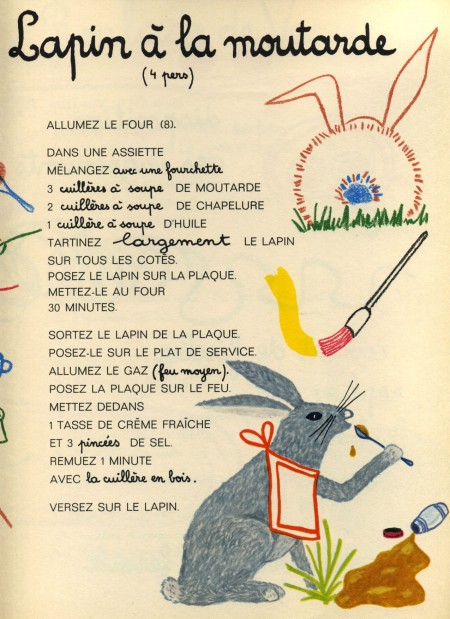
 - Whimsical illustrations.
- Seen on this blog it explains about the book that the ingredients and the steps are kept to a minimum, but the flavors are complex.

There is a modernized version, made into a TV series, which had fresher, brighter illustrations:


Cookbook for Boys


- Published by Usborne books
- Bright masculine colours.
- Age range: 8+


- Photography mixed with playful illustrations. 
- Easy recipes that young boys would enjoy. 


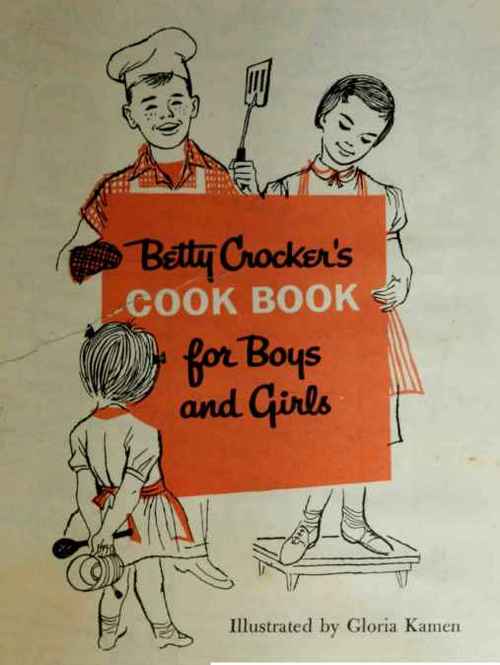
Betty Crocker's Cook Book for Boys and Girls
-  Published in 1957
- Also contained information such as manners and setting the table!
- Motherly vibe

- Illustrated by Gloria Kamen.
- Realism mixed with cartoon-like illustrations.
- Charming illustrations.
- Maximum of three colours used per page, though mainly black and white with splashes of colour.


References:
http://www.scrubbles.net/2013/10/23/james-beards-fireside-cook-book/ 
http://www.theliterarygiftcompany.com/fairy-tale-feasts-a-literary-cookbook-3451-p.asp 
http://uk.phaidon.com/store/childrens-books/the-silver-spoon-for-children-9780714857466/ 
http://tommytoy.typepad.com/tommy-toy-pbt-consultin/2013/05/an-ingenious-cookbook-uses-infographics-instead-of-words.html 
http://www.pinterest.com/pin/82120393178902158/ 
http://thehistorykitchen.com/2013/10/28/popcorn-balls/ 
http://popbetty.com/2007/09/childrens-pictu.html 
http://www.chocolatecakemoments.com/which-kids-cookbook-should-you-choose/ 
http://hazel-catkins.blogspot.co.uk/2012/04/betty-crockers-cook-book-for-boys-and.html 

Cookbook Reseach (1)

For the main brief of my project, I decided to undergo research in the area of children's cookbooks, looking from vintage books to modern. 

Fun To Cook Book
- First published in 1951 by the Carnation Company.
- Created to advertise advertise the Carnation Company, as the book uses several Carnation products in the recipes given.
-  Illustrative style is charming. The red-headed girl is sweet and has a pleasing simplistic visual language. This young character would appeal to children, as they would be able to identity with her.

- The first page introduces this red-haired character. She is introduced as Margie Blake, the daughter of the author, Mary Blake. The introduction reads: "When I teased Mother to let me cook, she looked in book stores for a cook book for me. Some books had too many long words. Some books were too babyish and just had play recipes... So Mother decided to write a cook book especially for me and other girls my age... I thought up the name "Fun to Cook Book". I know you'll have fun cooking too."
- Therefore, this book was designed specifically with children in mind.

 - The inside layout of the book is easy to read and understand. Chunks of text are not overwhelming to a younger audience with the inclusion of bright illustrations, which usually contain primary colours.
- The language of the book is informal. As though it's a conversation between the character and the child cook. 

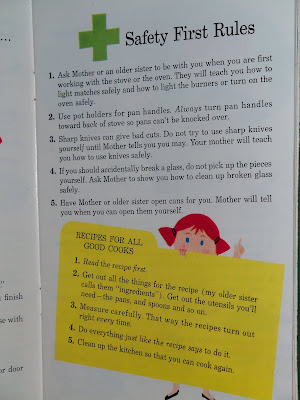
- Typical of children's cooking books, there is a health and safety section.
- The character appears throughout the book on post pages.

 - There is also a storyline developed, to involve the children more in the book. The voice of the book is told through a child, which makes it easier for a young person to read and get involved in.
- These books are said to be aimed at children 7-9. Though I think even younger children would be able to enjoy the language and illustrations of the book, though they might need help with the recipes.


100 Yummy Things To Cook & Eat
- First published in 1995 by Usborne Publishing.
- Each recipe contains a ‘You will need’ list, simple instructions, clear step-by-step illustrations and a  photograph of the end result.
- Contains mainly treats, such as cakes and cookies.
- Photography mixed with sweet illustrations. Loosely drawn.

 - Double page spreads. Photography one side of final results, illustrations of step-by-step progress on next page.
- Calming colours. Soft blues, yellows, purples pinks etc.
- Each page has a consistent style and layout.
- Language is very to the point, with no added frills. This makes it easier for children to understand.


The Children's Cookbook

- Published by Perrem & Cave. 
- Playful front cover. Typography created from fridge magnets. Mixed with children's illustrations. Objects from a child's world.


- Photography mixed with chunks of text. I think this text may be difficult for the child to read, especially since they have such a short attention span; they may get bored by these thick paragraphs.
- This book seems more designed for the parent and the child. The parent would be the one in charge of reading the instructions, helping the child.
- Soft pastel colours. Aimed at girls?
- Simplistic, to-the-point layout.


My Fun-to-Cook-Book

- Published in 1969 by Western Publishing Company
-  Illustrated by Martin Mayhew.
- Loosely detailed, child-like illustrations. Messy, fun, carefree, bright - perfect for children.
- Seemed to have been done with coloured texta's, felt tips or magic markers.

 - Illustrations are very prominent. Greatly outweigh the text. This is suitable for the young audience.
- Characters such as a dog and cat (seen above) also appear, as children connect with characters more.

- Illustrative diagrams to go along with instructions.

- Illustrations do not have to be polished or too finished to be attractive and successful.


How To Cook The Perfect Day
 - Minimal colour. Black and white combined with blue. This makes the book appear strongly graphical, bold and different. This would stand out to me on a shelf.
- Illustrations are similarly effective. Realism mixed with a cartoon style.
- This is a small book - 32 pages.
- By Nikki McClure, who uses x-acto knife to cut her designs into paper.


- Language is informal. Chatty.
- Text broken into different paragraphs; stops it looking like too much to read. 
- Blue, black and white continue into the inside of the book. No other colours can be seen.
- Visual language is unique.


References:
http://goldcountrygirls.blogspot.co.uk/2011/04/vintage-childrens-cookbooks-2-fun-to.html
http://vanalogue.wordpress.com/2013/07/07/vintage-recipe-pamphlets/
http://www.usborne.com/catalogue/book/1~c~ccbc~6401/100-yummy-things-to-cook-and-eat.aspx
http://www.perremcave.com/portfolio/the-childrens-cook-book/
http://lucyking-bowerbird.blogspot.co.uk/2012/11/a-rather-quirky-second-hand-kids-cook.html
http://www.buyolympia.com/q/Item=how-to-cook-the-perfect-day

Sunday, 9 March 2014

Making Easy Cheesy Eggy Bread


A. What was the recipe you chose and ‘why’?
I chose to make the Easy Cheesy Eggy Bread recipe, as I thought it sounded the most tasty. Not being a particularly good cook, I also wanted to start out with something easier.


B. Where did you buy your ingredients, how much did they cost, what is the country of origin of your ingredients?
Eggs
I first went to a local, organic shop: The Housewives Choice Fruiters. I unfortunately couldn't find all of the ingredients here, but I did find the eggs. They were £1.20 and were from Shavington, Crewe, 84 miles away.

Chives
The chives were more difficult to find. I had to settle with buying them from Sainsburies. They were 80p. However, they came from Kenya, a staggering 6,5550 miles away! However, chives can be grown in the UK, so why are they being shipped from Kenya?!

Cheddar Cheese
I bought the cheddar cheese from Co-op. It was £2. The label said that it was British cheese, yet it did not specify which part of Britain.

Bread (Crusty Cob)
The bread I bought was made in Co-op, only 0.5 miles away from my house. It was £1.


C. Depending on which dish you chose to demo, it may be designed for one or more people. Try to guess at how much it cost per plate of food served.
I made the meal for two and we had a lot of ingredients left over.

3 medium eggs = 60p
Four chives = Roughly 5p
30g cheese = Roughly 30p
2 slices of bread = Roughly about 25p

Total per plate of food served: Roughly £1.20


D. Roughly how long did it take for you to make? Do you think if you attempted it again that it would take you as long?
It did not take that long to make this meal. Perhaps 15 minutes. Now that I know how to make it, I don't think it would take as long to make in the future.


E. If there were improvements to your recipe you’d thought of during your experiences then what would these be?
I actually thought this meal was very tasty. I could use different types of bread to change the taste.